
Self-Managing an Airbnb vs Hiring a Property Management Company: Which Makes More Profit?


By Effortless Stays
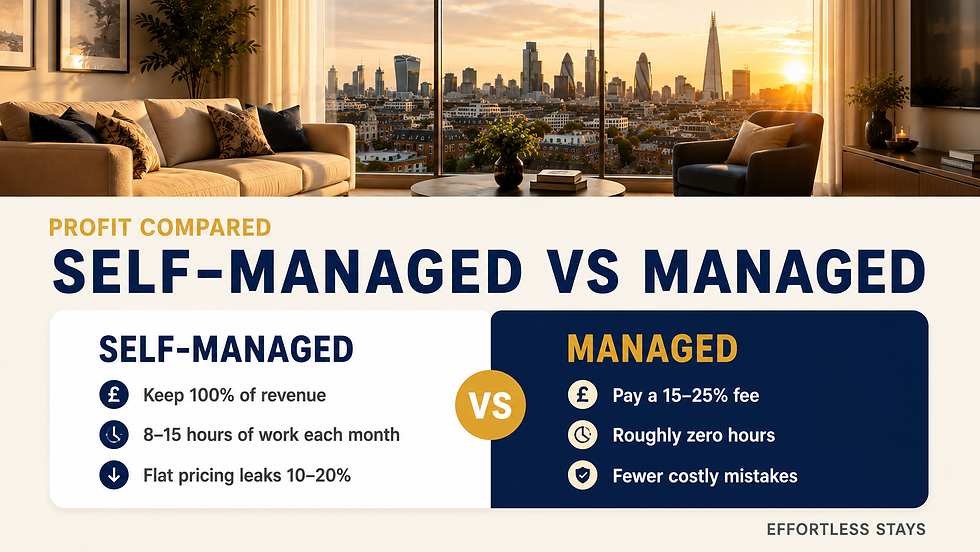
Short answer: self-managing wins on paper and loses in practice for most landlords. You keep the 15-25% management fee, but you take on 8-15 hours of work per property per month, plus the cost of every empty night your pricing gets wrong. A good management company usually earns its fee back through higher occupancy, better nightly rates, and fewer costly mistakes. The real question is whether your situation is one of the exceptions where doing it yourself pays.
This guide breaks down the real numbers, not the marketing ones.
The comparison nobody shows you honestly
Most articles on this topic are written by management companies who want you to hire them, or by hosts who want to sell you a self-management course. Both have a reason to skip the awkward parts.
Here is the honest version. Three things decide which route makes more profit:
How much revenue each approach actually generates (not just what you keep from it)
What your own time is worth, and whether you have any to spare
How much the mistakes cost when something goes wrong at 11pm and you are 200 miles away
Self-managing only wins when all three line up in your favour. For most landlords, at least one of them doesn't.
Route 1: Self-managing your Airbnb
When you self-manage, you keep 100% of the booking revenue minus platform fees. On a property earning £2,000 a month gross, avoiding a 20% management fee saves you around £400 a month. That is real money, and it is why self-managing looks so attractive on a spreadsheet.
Here is what that £400 actually buys you each month.
The work you take on:
Writing and refreshing the listing, and keeping photos current
Adjusting nightly prices for demand, events, and seasonality, ideally several times a week
Answering enquiries fast (response speed directly affects your ranking and conversion)
Coordinating guest check-ins, check-outs, and access
Booking and quality-checking cleaners between every stay
Restocking consumables and replacing worn or broken items
Handling complaints, refunds, damage claims, and the occasional 2am lockout
Staying compliant with registration, safety, and tax obligations that changed significantly in 2025
Across a single property, that is realistically 8 to 15 hours a month once you include the small interruptions that don't show up on a to-do list. Two or three properties and it becomes a part-time job with no fixed hours and no days off.
The hidden cost of getting it slightly wrong:
The biggest cost of self-managing is rarely the hours. It is the revenue you never see. Pricing a property well takes constant attention to local demand. A self-managed listing that sits at a flat nightly rate typically leaves 10-20% of potential annual revenue on the table through empty midweek nights and underpriced peak dates. On a £24,000-a-year property, that gap can quietly cost you £2,400 to £4,800, which is more than a management fee would have.
Self-management makes more profit when:
You have one property, live nearby, and genuinely enjoy the operational side
You have real time to spare and treat pricing as an active job, not a set-and-forget
Your local cleaning and maintenance network is already sorted and reliable
From the Effortless Stays team
The single most common thing we find when taking over a self-managed property is not bad reviews or tired photos. It is a nightly rate that has not moved in months. The owner set a price that felt right once, then got busy, and the calendar quietly filled the cheap nights while missing the expensive ones. Fixing the pricing alone often changes the numbers more than anything else we touch.
Route 2: Hiring a property management company
A management company handles the entire operation for a percentage of revenue, typically 15-25% in the UK, depending on the service level and whether cleaning is included or billed separately.
You give up that slice. In return, a good company should deliver three things that offset it:
Higher occupancy and nightly rates through active, data-led pricing and faster guest response
Lower operational cost through established cleaning and maintenance relationships and bulk supply
Fewer expensive mistakes, such as a mispriced peak weekend, a bad review from a slow reply, or a compliance slip that triggers a fine
The fee is not a cost sitting on top of your existing return. It comes out of a larger pot that active management is meant to create. That is the part the "just keep the 20%" argument ignores.
A management company makes more profit when:
You own more than one property, or live far from it
Your time is worth more elsewhere, whether running a business, a full-time job, or simply having a life
You want predictable, hands-off income rather than a second job
You are not confident on the 2025-2026 rule changes (registration, planning, the tax shift) and would rather someone else carry that risk
The real maths, side by side
Here is a simplified example for a property grossing £2,000 a month under flat self-managed pricing.
Self-managed:
Gross revenue (self-priced): £2,000
Management fee: £0
Your time: around 10 hours a month, which is yours to spend
Revenue you keep: £2,000, for ~10 hours of work
Managed (20% fee):
Gross revenue (actively priced, +15%): £2,300
Management fee: -£460
Your time: around zero
Revenue you keep: £1,840, for ~0 hours of work
On these numbers self-managing keeps you £160 more a month, if you value your 10 hours at nothing and if your self-managed pricing matches what a managed listing would earn. Change either assumption and the result flips. If active management lifts revenue by more than the fee, or if your time is worth even £16 an hour to you, the management route already comes out ahead.
These are illustrative figures. Your actual numbers depend on location, property type, and season. Run your property through our income calculator to see a realistic figure for your address.
The question that actually decides it
Forget the percentages for a moment. Ask yourself one thing:
Will you actually do the work, consistently, at the standard the property needs, every week, indefinitely?
Most landlords answer yes in month one and no by month four. Enthusiasm handles the setup; it does not handle the 40th changeover coordination or the guest who wants a refund on a spotless flat. That drop-off is where self-managed returns quietly erode, as occupancy slips, reviews soften, and the pricing goes stale.
If the honest answer is "probably not for long," the management fee is not a cost. It is insurance against your own future workload.
How we think about it at Effortless Stays
Across the properties we manage in Birmingham, Leicester and Manchester, the pattern is consistent: the biggest gains come from active pricing and fast guest response, not from cutting corners on cost. That is exactly the work that is hardest to sustain on your own alongside everything else.
We are not going to tell you every landlord should hand over management. Some genuinely shouldn't, and we'll say so. But if you own more than one property, live away from it, or simply want your evenings back, the maths usually favours letting a team run it.
Next step
Not sure which side of the line your property falls on? The fastest way to know is to compare your realistic managed earnings against what you're making now.
Check your property's earning potential in the calculator: takes about two minutes
Book a short call and we'll give you an honest read on whether management makes sense for your specific situation, no pressure either way


Comments